


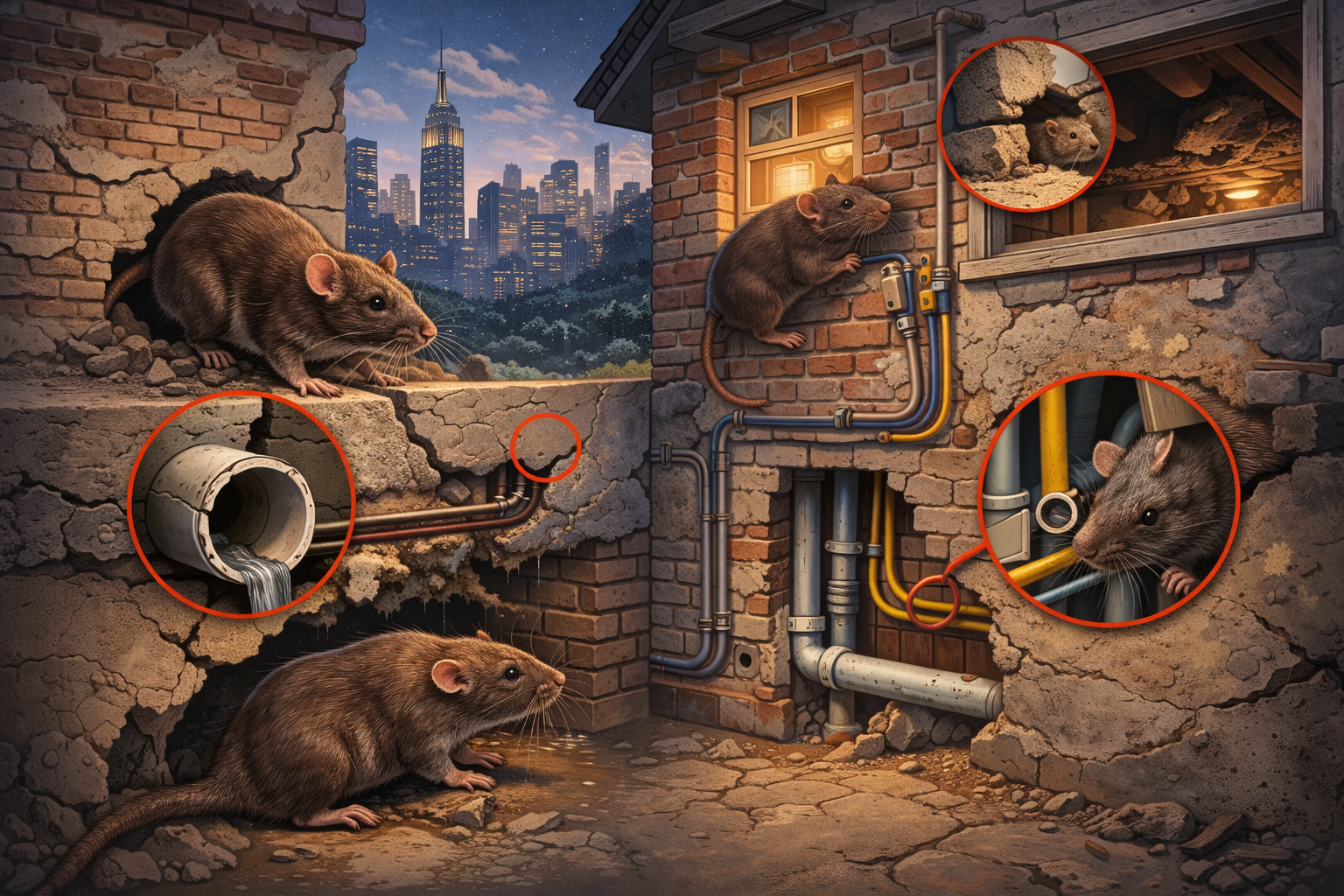
How Rats and Mice Enter NYC Homes Through Basements, Walls, and Utility Lines
Most New Yorkers know that rodents are a fact of city life. But what surprises many homeowners is just how easily rats and mice find their way indoors, not through an open door, but through the hidden gaps in your home’s foundation, walls, and utility lines that you may not even realize are there. Understanding how rodents get in is the first step toward keeping them out.
Smaller Than You Think
A mouse can squeeze through any opening as small as a quarter inch in diameter, roughly the width of a pencil. Rats need a bit more room, but not much; a gap the size of a quarter is all it takes for a Norway rat, the species most common across New York City, Long Island, Westchester, and Rockland County. These animals are built to compress their bodies and push through tight spaces, which means the average home has dozens of potential entry points hiding in plain sight.
The Most Common Entry Points for Mice
Basements and foundations. Cracks in your foundation, gaps where the sill plate meets the concrete, and openings around basement windows are prime entry points. Rats are strong enough to gnaw through PVC plumbing pipes, and they’ve been known to undermine foundations and destroy structural support beams in the process. In older New York homes, settling and wear create new gaps every year.
Utility lines and pipe penetrations. Anywhere a pipe, wire, or cable enters your home is an invitation for rodents. Plumbing connections, electrical conduits, gas lines, and HVAC ductwork all create small gaps where they pass through exterior walls. Mice are especially adept at wiggling through these narrow spaces around pipes and wires, and once inside the wall cavity, they can travel freely throughout your home.
Walls, soffits, and rooflines. Rodents don’t just come in at ground level. Rats and mice can climb brick, stucco, and siding to reach gaps around soffits, roof vents, and deteriorating trim. Black rats in particular are skilled climbers. Once inside your attic or wall voids, they build nests using shredded paper, insulation, and fabric, and a female mouse can produce a litter of eight pups every four weeks.
Why It Matters More Than You Think
The damage goes well beyond the unpleasant sight of droppings in your kitchen drawer. Rats are known to chew through electrical wiring, creating a genuine fire hazard. They gnaw through plumbing, which can lead to water damage. Their droppings and urine contaminate surfaces and food, and both rats and mice are vectors for diseases including Salmonella, leptospirosis, and Typhus. They also carry fleas, ticks, and mites into your home, bringing a second wave of pest problems with them.
And once rodents identify your home as a reliable food and shelter source, they don’t give up easily. Researchers have tracked mice traveling over four miles, swimming streams and crossing highways, to return to a home they were removed from. It can take several generations before the problem is truly resolved.
A Professional Approach to Rodent-Proofing
A single trap or bait station is unlikely to solve a rodent problem on its own. Effective pest control requires identifying and sealing entry points, deploying the right combination of traps and treatments for your specific situation, and monitoring over time to ensure they don’t return.
At Knockout Pest Control, our technicians are trained to think like rodents, inspecting your home from the foundation to the roofline to find every potential access point. We use an Integrated Pest Management approach with environmentally responsible, GreenPro-certified solutions that are safe for families and pets. Our KO-12 annual plan provides year-round monitoring and treatment so rodent problems are caught early, before a couple of mice become a full infestation.
If you’re hearing scratching in the walls or finding droppings along your baseboards, don’t wait. Knockout Pest Control has been protecting New York homes since 1975, and we respond to every call like an emergency. Reach us at (800) 244-7378 for a free estimate, or contact us through our website.